
USP Allenwood Release Paths
Leaving USP Allenwood does not always mean leaving federal custody. A prisoner can transfer to another penitentiary, an FCI, a medical center, a detention center, or a community-corrections placement. `IN TRANSIT` describes movement and cannot be converted into a release claim. Only a past Release Date accompanied by `RELEASED`, no facility, or another clear BOP indication of departure supports the end of BOP custody.
A completed BOP release also may not end all legal control. The federal court can impose supervised release after imprisonment. Another jurisdiction may hold a detainer. If BOP transfers the person to that authority, the BOP event is a release from federal prison custody to a named custodian, not a return to the community. Exact words matter.
| USP Allenwood event | Meaning | Evidence to seek |
|---|---|---|
| Transfer to another BOP facility | Continued federal custody | New BOP Location |
| IN TRANSIT | Movement, destination pending | Updated BOP result |
| Past date and RELEASED | BOP custody ended | Release notice and docket |
| Release to detainer | Another authority assumes custody | BOP record and receiving record |
| Supervised release | Community supervision after prison | Federal judgment and docket |
Confirm a USP Allenwood Release
Use the BOP inmate locator, which covers federal inmates released from 1982 forward. Search the BOP register number when available. It is the most reliable public identifier. The search also accepts DCDC, FBI, and INS numbers. A name query can use age, race, and sex to reduce false matches.
- Search the register number or exact name with the relevant narrowing details.
- Verify identity before using any date, especially when the name is common or has aliases.
- Read Location and Release Date together, and confirm whether USP Allenwood fits the known chronology.
- Do not call `UNKNOWN`, `IN TRANSIT`, or another BOP institution a release.
- For a past release result, check the federal docket and request the release record when the next destination matters.
BOP says the locator is extracted daily. Its public result can trail the source transaction. Future release dates can change after calculation updates. Save the date of the lookup and state whether the displayed date was future or past at that time. Do not present a projection as a promised release.
USP Allenwood Release Documents
The locator establishes a public BOP result, but a documentary record can explain the event. BOP's BP-A0714 Notice of Release and Arrival illustrates fields such as release method, releasing institution, destination, proposed residence, travel details, supervising or detaining authority, arrival plans, and reporting instructions. A notice with those fields can distinguish community release from a handoff to another custodian.
Follow BOP's official locator records guide and federal FOIA process. A narrow request should identify the full name, register number, USP Allenwood, and a defined release period. Ask for the existing release notice or custody-ending record. BOP may require DOJ-361, consent, identification, or proof of death, and exemptions can lead to withheld or redacted material.
The federal docket provides the legal record. PACER may contain a judgment, sentence, supervised-release conditions, detention or release order, revocation, or transfer-related filing. The court's timestamp is not necessarily the time prison staff completed the custody event. Preserve the legal-authority date and agency-processing date as separate facts.
Note: A source record should be quoted by its exact event label because release, transfer, supervision, and discharge are not interchangeable.
Interpret USP Allenwood Status
A future Release Date is projected and may be recalculated. For certain parole-eligible offenses committed before November 1, 1987, it can reflect a statutory date subject to earlier Parole Commission action. A past date supported by a released status records the end of BOP custody. The date says nothing by itself about whether supervised release or another sentence continued.
- RELEASED
- The person is no longer in BOP custody.
- Not in BOP Custody
- An agency-specific status that does not rule out another custodian.
- UNKNOWN
- The public system does not have a resolved confinement term.
- IN TRANSIT
- The person is moving, not shown as released.
- Community Corrections
- A reentry placement that may remain within federal authority.
When sources disagree, compare update times and scope. A court order can authorize release before BOP processes it. BOP can report release while a state or local jail truthfully reports current custody. Build a chronology with each fact assigned to the office that created it.
For records before 1982, BOP directs researchers to the National Archives. Absence from the current locator does not settle an older federal incarceration. Likewise, a spelling error or missing alias can cause a false no-result.
USP Allenwood Federal Record Limits
The U.S. Marshals Service handles federal pretrial and other prisoners who may never appear as sentenced BOP inmates. If a federal defendant was detained but never committed to BOP for a sentence, no USP Allenwood release result may exist even though the federal docket shows custody events. Search PACER and contact USMS or the known contract custodian.
Union County Jail cannot certify a USP Allenwood release merely because the penitentiary is in Union County. County Right-to-Know requests reach county records, not BOP files. PADOC covers Pennsylvania state inmates and parolees. PA SAVIN covers participating county and state sources. None replaces BOP for a federal sentence.
The permitted body of evidence is therefore small and clear: the BOP locator for public status, the BOP release record for method and destination, the federal docket for legal authority and supervision, and the receiving agency when another custodian followed.
USP Allenwood Federal Release Search
Union County combines its small county jail with FCC Allenwood's three federal institutions. A search by county name can hide the most important fact: which government held the person. USP Allenwood is federal and high security. It has no release relationship to Union County Jail's local custody ledger, and it does not belong in PADOC's state-prison locator.
The official BOP facility results identify USP Allenwood separately from both FCIs. That distinction protects the custody history from being flattened into a generic “Allenwood” record. A transfer from the penitentiary to an FCI is not release. A past BOP release date is meaningful only when paired with the corresponding status.
The official BOP Allenwood directory results establish the three distinct federal institutions.
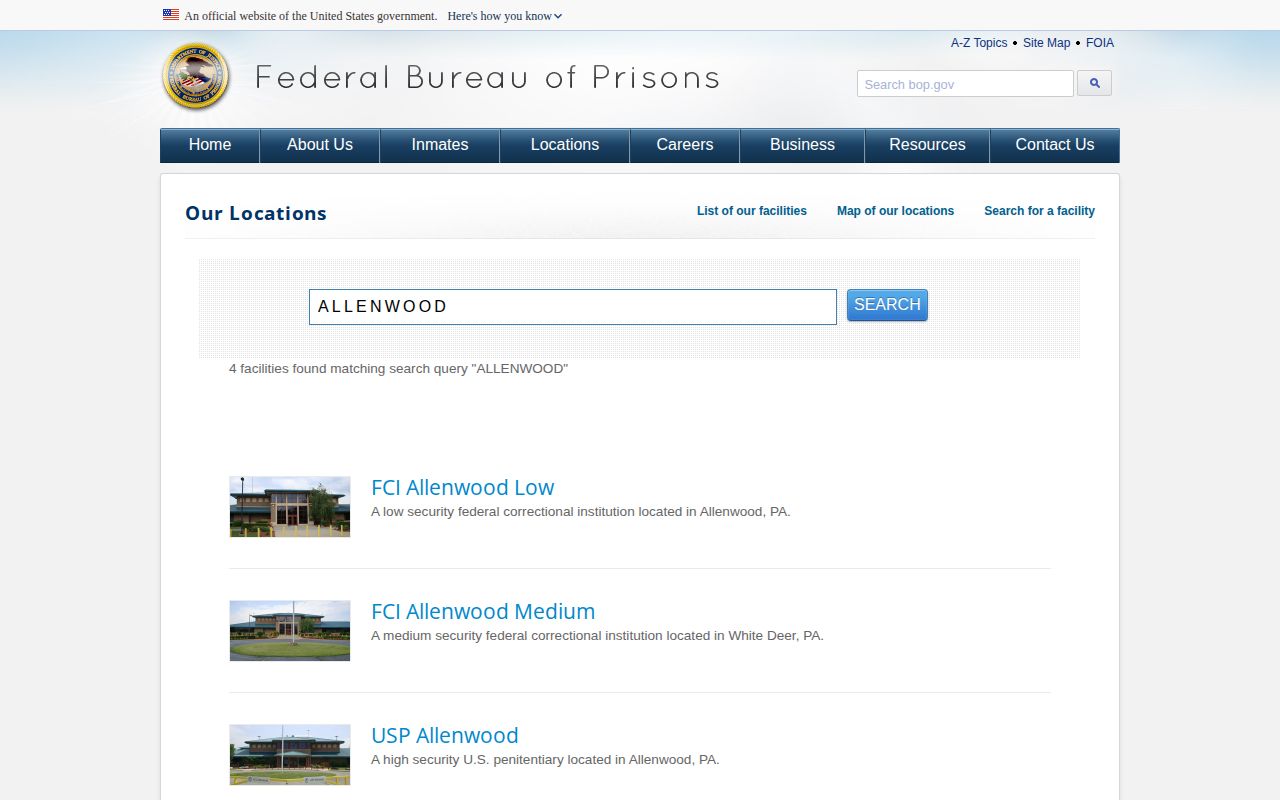
The directory image confirms USP Allenwood's institutional identity. It does not confirm an individual release, sentence date, or destination.
USP Allenwood Records Contact
Consult the official BOP directory for current institutional contact details. Use “USP Allenwood” in full. The complex also includes two FCIs, and a request using only the Allenwood place name can reach the wrong institution.
USP AllenwoodAllenwood, Pennsylvania
Security: High
Operator: Federal Bureau of Prisons
Public release source: BOP Inmate Locator
Direct a status search to the BOP locator, a documentary request to BOP's federal records process, and a legal-order question to the federal docket. If a BOP release record identifies a detainer, route the next inquiry to the receiving authority.
The broader Union County release search helps determine which custody system applies before a record request is filed.
A high-security institution may generate a complex transfer history, but security level alone proves nothing about a named person's release method. Follow the stable register number across each BOP Location. Mark every transfer as movement within custody until a source records a completed release. If the person later appears under another authority, compare the receiving date with the BOP event and keep both agency names. A gap between those entries should be reported as unresolved rather than filled with an assumption. When the federal docket has a release order but the locator still shows custody, compare update times and seek the institutional transaction. The legal order and physical processing can occur at different moments.
Note: Confirm the institution and register number before requesting a record so a same-name result or sibling Allenwood facility is not used.
Update USP Allenwood Release Records
A dated BOP release result remains a record of that federal custody event even if the person later returns to custody. Report the later event separately. Do not rewrite an earlier release as false solely because a new arrest, revocation, or sentence appears.
When a public result is wrong, send the correction to the source that owns it. BOP controls its locator and prison record. The federal clerk controls PACER docket entries. A receiving state or county agency controls its later custody ledger.
Public Record Search
Sponsored Results