
FCC Allenwood Release Structure
Federal Correctional Complex Allenwood is the Bureau of Prisons' administrative complex for three separate federal institutions in Union County. FCI Allenwood Low is low security. FCI Allenwood Medium is medium security. USP Allenwood is a high-security United States penitentiary. The complex name may appear in general BOP material, but it should not be treated as a separate fourth inmate-housing institution unless a source record itself uses that designation.
That distinction affects every release inquiry. Search the person, not just the word “Allenwood,” then read the BOP result's Location and Release Date together. A move among the three institutions is not a release from federal custody. Neither is an `IN TRANSIT` result. A Community Corrections Management location can reflect a halfway-house or community-corrections stage while BOP authority continues. The status label and date must be kept with the institution name.
| Allenwood component | Role | Correct release route |
|---|---|---|
| FCC Allenwood | Administrative umbrella | Identify the actual institution, then use BOP |
| FCI Allenwood Low | Low-security institution | BOP locator and federal record |
| FCI Allenwood Medium | Medium-security institution | BOP locator and federal record |
| USP Allenwood | High-security penitentiary | BOP locator and federal record |
Confirm an FCC Allenwood Release
The BOP inmate locator covers federal inmates released from 1982 to the present. Search by BOP register number for the strongest match. The locator also accepts DCDC, FBI, or INS numbers, and it permits a name search narrowed by age, race, and sex. The result shows the person's name, register number, current age, race, sex, Release Date, and Location or status.
- Search the register number when known, since it remains more reliable than a common name.
- Open the matching result and confirm that the identity and Allenwood institution fit the known federal record.
- Read Release Date and Location together. A future date is projected, not completed.
- For a past date, look for `RELEASED`, no facility, or another clear BOP status consistent with departure.
- Use the federal docket or BOP release document when the method, destination, detainer, or supervision terms matter.
BOP says locator data is extracted daily. A recent change can lag the source event, and First Step Act calculations can change a future date. Record the date and time of the check. For broader Union County custody routing, the Union County released-inmate search distinguishes federal, county, state, and immigration sources.
Read FCC Allenwood Release Results
A future Release Date is a projection. It can change as federal sentence calculations change, and for certain older parole-eligible offenses it may be subject to Parole Commission action. A past date with `RELEASED` or no facility supports the conclusion that BOP custody ended on that date. It does not prove that all legal control ended. Federal supervised release, which is court-ordered community supervision after imprisonment, can begin at that point.
- Released
- No longer in BOP custody as of the recorded event.
- In Transit
- Moving within federal custody or between placements, not free from custody.
- Community Corrections
- A halfway-house or related stage that may still fall under BOP authority.
- Detainer
- A request or legal basis for another authority to assume custody.
- Supervised release
- Federal court supervision that can continue after prison custody ends.
The language should remain agency-specific: “released from BOP custody” is more accurate than “free” or “fully discharged.” If another authority takes custody, the BOP date marks one transition in a longer chain. Check the receiving authority and federal docket before describing the destination.
Note: A past BOP date confirms the federal custody event only when the accompanying Location or status supports release.
FCC Allenwood Release Records
The public locator is a strong first check, but it is not the full release file. BOP's BP-A0714 Notice of Release and Arrival illustrates the added detail an agency document may contain: release method, releasing institution, destination, proposed residence, travel and arrival information, supervising or detaining authority, and reporting instructions. Those fields distinguish community release from release to another custodian.
For additional releasable information, follow BOP's locator records guidance and its Freedom of Information Act process. The agency may require identity details and the proper authorization or proof of death for some records. DOJ-361 is the certification form referenced by BOP. A request should name the person, give the register number if known, identify the relevant institution and date range, and seek an existing release document rather than ask the agency to create a summary.
Federal court records supply a different kind of proof. PACER may show a judgment, detention or release order, revocation, or conditions of supervised release. The court order gives legal authority and context. The BOP transaction or release notice gives the custody outcome. Preserve both dates if court action and physical processing occurred at different times.
FCC Allenwood Release Limits
Not every federal defendant in Union County becomes a sentenced BOP prisoner. The U.S. Marshals Service manages federal pretrial and other prisoners, often through contract facilities, and it does not offer a universal public former-detainee name locator. A missing BOP result is therefore expected when someone remained a USMS detainee and never entered sentenced BOP status.
For that situation, search PACER for detention, bond, release, judgment, revocation, and transfer orders. Contact the Middle District of Pennsylvania USMS or the known contract custodian when a source identifies one. A court release order shows what a judge authorized, while the custodian's record shows whether the order was carried out and whether a separate hold affected departure.
Union County Jail and PADOC are also scope-limited. The local jail can confirm only its own custody. PADOC covers Pennsylvania state-sentenced inmates and parolees, not federal Allenwood prisoners. Geography does not merge these systems.
Allenwood Federal Release Footprint
Three federal institutions in one Union County complex make the BOP locator unusually important here. A search based only on local geography can send a reader to the county jail or the Pennsylvania Department of Corrections. Both are wrong for a person who served a federal sentence at Allenwood. First identify the sovereign, meaning the government authority that held the person, then use that authority's system.
The official BOP directory is also the best way to keep the institutions distinct. It prevents a low-security FCI record from being merged with the medium-security FCI or the high-security penitentiary. Security level describes the institution and custody setting; it does not change the need to read Release Date and Location together.
The official Allenwood facility results show the three institutions associated with the federal complex.
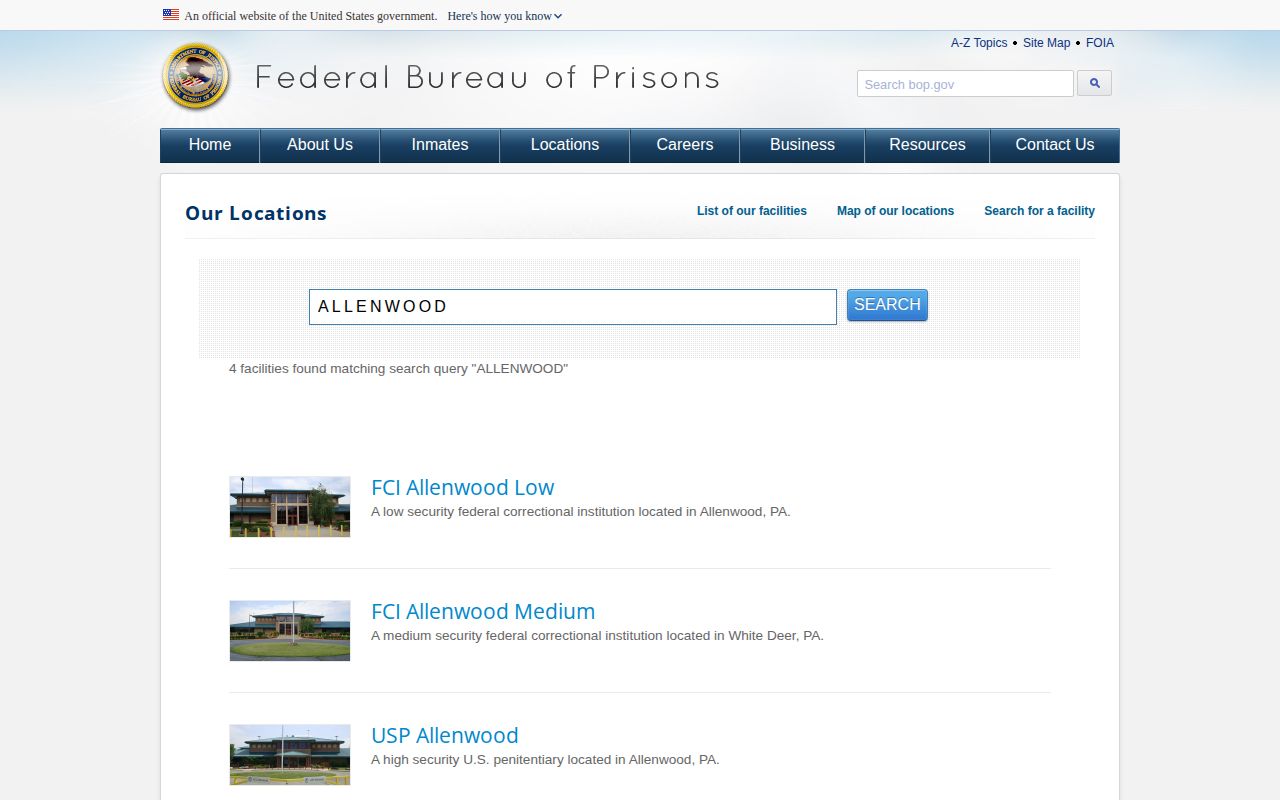
The image confirms the institutional structure. It does not show that any named prisoner was released or transferred.
FCC Allenwood Release Contact
Use the BOP directory for current institutional information and the locator for a public status check. An inquiry should specify whether it concerns FCC administration, FCI Allenwood Low, FCI Allenwood Medium, or USP Allenwood. That precision helps avoid a response about the wrong institution and keeps the release event tied to its actual custodian.
Federal Correctional Complex AllenwoodAllenwood, Pennsylvania
Operator: Federal Bureau of Prisons
Public status: BOP Inmate Locator
Detailed release record: BOP FOIA or federal docket
No federal-release inquiry should be sent to the Union County Open Records Officer merely because the complex lies in Union County. County Right-to-Know procedures govern county records. Federal BOP records use federal disclosure rules. If a detainer transferred the person elsewhere, direct the next inquiry to the receiving authority identified in the BOP document or docket.
A well-framed inquiry also separates current location from historical release. The BOP directory answers which Allenwood institutions exist, while the inmate locator answers a named person's public status. The release notice can document the method and destination. A PACER docket can then show the judgment or supervision order. Combine these sources only after the register number, institution, and dates match. When a result names the complex but not an institution, do not choose one by security level or assumption. Ask BOP which component created the record. When an institution appears in an older record, verify that name against the official directory before describing the custody event. This sequence preserves the difference between FCC administration and the prisons it supports.
Keep a dated copy of each official result and preserve its exact status language. That record makes later changes in placement or release easier to explain without guesswork.
Note: State the exact Allenwood institution in every request because FCC is an umbrella name and the three prisons maintain distinct identities.
Public Record Search
Sponsored Results