
Union County Projected Release Dates
A projected date is an estimate based on the sentence and information known at the time. An actual release date records when the custodian completed the event. Those dates may match, but they answer different questions. A court's minimum sentence date may establish the first ordinary parole eligibility point. It is not a promise that the Pennsylvania Parole Board will grant parole on that day.
Pretrial custody works differently. Before sentence, Union County Jail cannot calculate a prison term that does not yet exist. Release may follow posted bail, recognizance, dismissal, a court order, or disposition. Another county, state, federal, or immigration detainer can prevent a return to the community even after one local case permits release. The jail's custody-ending entry provides the physical event; the court docket explains the legal action.
For state confinement, separate minimum eligibility, RRRI minimum, anticipated processing, actual parole release, and maximum expiration. For federal confinement, the BOP locator may show a future Release Date as projected. A past BOP date with no facility supports the end of BOP custody, though supervised release or another custodian may follow.
Find a Union County Release Date
There is no single Union County date search covering every custodian. The county jail, Pennsylvania courts, PADOC, and BOP own different parts of the chronology. Start with an identifying number when possible. A county booking number, UJS docket number, PADOC inmate or parole number, or BOP register number is safer than a name-only match.
- Decide whether the person is a pretrial or county-sentenced jail inmate, a state prisoner or parolee, or a federal prisoner. Geography alone is not enough because Allenwood federal institutions are located in Union County.
- For county custody, call Union County Jail and ask for the current status. If the person departed, ask whether the event was direct release, transfer, or release to another authority.
- Search the UJS case portal at the Magisterial District Judge and Common Pleas levels. Read bail, sentence, credit, disposition, and later modification entries.
- For state custody, search the PADOC inmate and parolee locator. Read the record type and fields literally. The public inmate detail does not show a projected date.
- Ask the correct agency for the controlling calculation or record. That may be the jail calculation, filed sentencing order, PADOC sentence-status record, or Parole Board Action.
The full Union County release search and record process helps when the person has already disappeared from the current custodian's public view. An absent result is not a date and does not prove sentence completion.
PADOC Lacks a Projected Field
Pennsylvania describes its public locator as a daily-updated search for state-sentenced inmates and parolees. It excludes people confined in county facilities or another state's system. The deployed interface reviewed for Union County offers name, inmate or parole number, committing county, sex, citizenship, location, age, and birth-date search fields. An inmate detail shows items such as Inmate Number, Current Location, Committing County, photo, and Last Updated Time.
The crucial limitation is plain: the public inmate detail has no Projected Release Date, Tentative Release Date, Minimum Date, or Maximum Date field. A parolee detail can show a Release Date, but that is an actual release from state confinement onto parole. It must not be relabeled as the projection for a person still incarcerated.
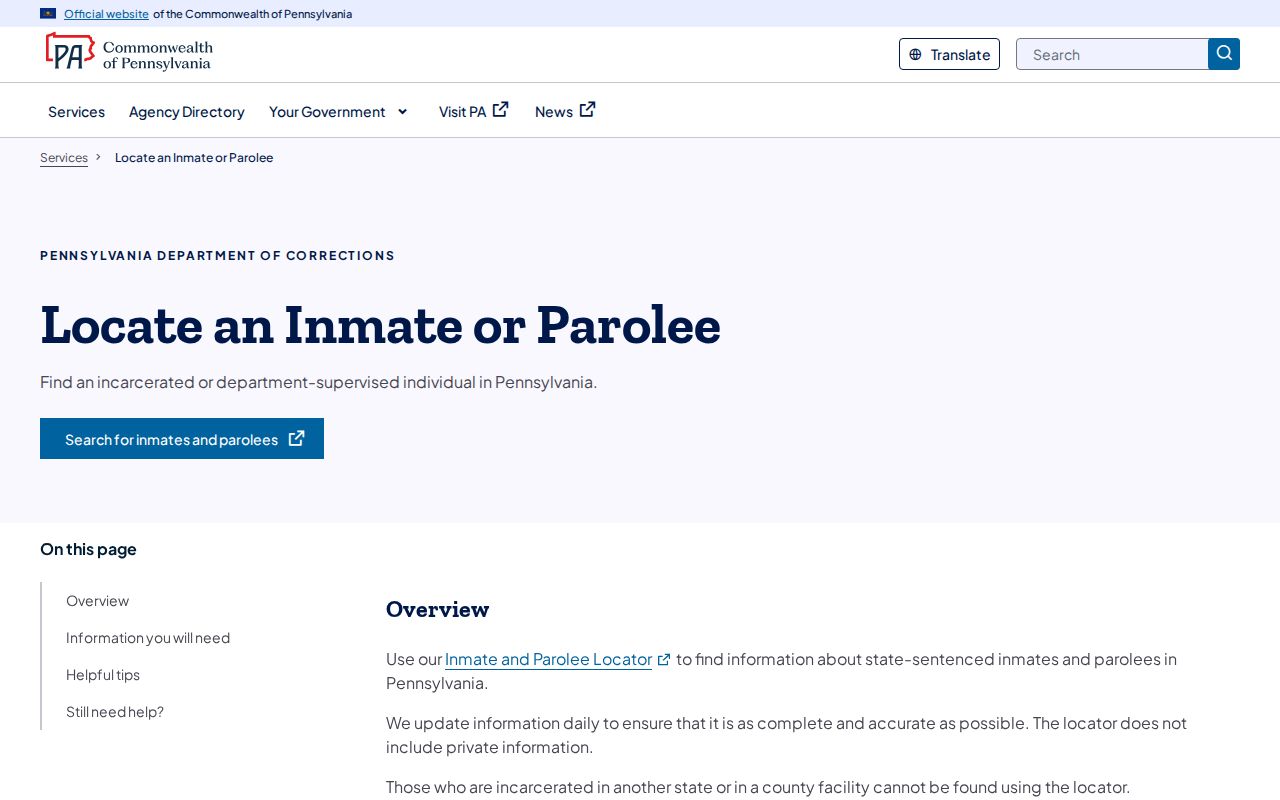
The official PADOC locator instructions describe the search scope. The manifest image below captures that official state route and supports the locator workflow, not the existence of a projected-date field.
When a state sentence date is needed, use the sentencing docket and credit entries, seek a Board Action for a parole decision, contact PADOC, or submit a focused Right-to-Know request for an existing sentence-status record. PADOC lists ra-contactdoc@pa.gov for locator help.
Pennsylvania Release Date Sentencing Rules
Pennsylvania ordinarily uses an indeterminate sentence with a minimum and a maximum. Under 42 Pa.C.S. § 9756(b)(1), a total-confinement sentence states both terms, and the minimum generally may not exceed half the maximum, subject to statutory exceptions. The minimum commonly marks the first parole-eligibility threshold. Under 61 Pa.C.S. § 6137(a), the Board may parole an eligible person after the minimum has expired.
The word “may” is key. Eligibility allows consideration; it does not compel release. The maximum is generally the sentence-expiration boundary, subject to lawful calculation, aggregation, credit, modification, violation action, and recommitment. A person may leave prison on parole before that maximum and remain supervised until the sentence ends.
- Minimum date
- The ordinary threshold for parole eligibility, not an assured departure date.
- Maximum date
- The sentence-expiration boundary after lawful calculations and changes are applied.
- Parole release date
- The actual date state confinement ended and community supervision began.
- Discharge
- The formal end of the sentence or supervision, which is later than many parole releases.
Sentence terms can be concurrent or consecutive. Concurrent terms run together to the extent ordered; consecutive terms run one after another. Presentence custody credit, a corrected credit award, an appellate decision, or a later sentencing order can change the calculation. The agency record should identify which date and source it is using.
No Universal Pennsylvania 85% Rule
Pennsylvania does not impose a universal rule that every state prisoner must serve about 85 percent of a maximum term before parole. The Pennsylvania Parole Board expressly rejects that broad claim. Importing the federal formulation into a Union County state case produces a false date. Ordinary Pennsylvania parole eligibility follows the judicial minimum, statutory exclusions, program rules, and Board discretion.
Risk Reduction Incentive, known as RRRI, is a targeted alternative. It is not general good time. Under 61 Pa.C.S. Chapter 45, an offender must meet defined eligibility criteria and exclusions. The sentencing court determines eligibility and imposes the RRRI minimum. For an ordinary minimum of three years or less, the statutory RRRI minimum is three-fourths of that minimum. When the ordinary minimum exceeds three years, it is five-sixths.
Even then, the RRRI minimum is an eligibility date, not guaranteed release. Institutional program completion and other requirements still apply. Short Sentence Parole under 61 Pa.C.S. §§ 6137.1 and 6137.2 is another distinct program with separate rules and exclusions. Eligible SSP matters may not require an interview, but SSP should not be described as county good time or routine sentence credit.
Note: Pennsylvania sentence calculations require the actual judgment and agency record; a percentage estimate cannot replace those sources.
Union County Jail Date Calculations
A Union County jail sentence requires the local sentencing order and the jail's own calculation. Credit for time served, concurrent or consecutive terms, court modification, and other holds can affect the result. The public county site does not publish a projected-release field, a county good-time rule, or a weekend-release policy. Any claim about those items would go beyond the available source.
Ask the jail for the existing calculation or policy that applies to the named sentence. Union County Jail is at 103 South Second Street in Lewisburg and lists 570-524-8711 with hours from 8:00 a.m. to 4:00 p.m. If documentary proof is needed, a focused county request should identify the person, booking or case number if known, approximate custody dates, and the existing calculation or custody-ending entry sought.
The court and jail prove different facts. A sentencing order states the judicial terms. A jail record shows how custody was processed. If the order says time served but the person remains held, ask whether another case, warrant, or receiving authority accounts for the continued custody. Do not convert the end of one case into a claim that every hold ended.
Why Union County Release Dates Change
A reliable record labels each change by source. Some events alter the legal sentence. Others change parole eligibility, processing, or the custodian that will receive the person. A date can move forward or backward, and not every change is visible in a public locator.
| Factor | Possible effect | Best source |
|---|---|---|
| Jail-credit correction | Changes time credited toward the term | Filed order and agency calculation |
| Concurrent or consecutive terms | Changes how multiple sentences combine | Sentencing orders |
| Parole grant or refusal | Allows release after eligibility or sets reconsideration | Board Action |
| RRRI or SSP eligibility | Creates a different statutory release path | Judgment and program record |
| Misconduct or program status | May affect a program or Board decision | Institution and Board records |
| Detainer or warrant | May send the person to another custodian | Custody entry and receiving-agency record |
| Modification or appeal | Can revise sentence terms or credit | Court docket and filed order |
A transfer does not create community release. If Union County hands a person to PADOC, another county, BOP, USMS, or ICE, county custody ends while the next authority begins or continues custody. Record the destination and check the receiving system.
Confirm a Union County Release
Near an expected date, check the source that holds the person. For a county inmate, call the jail and obtain the custody-ending record if an exact event matters. For a state prisoner, compare the court sentence, PADOC information, and any Board Action. For an Allenwood federal prisoner, use the BOP locator, where a future Release Date is projected and a past date plus no facility supports the end of BOP custody.
PA SAVIN and VINELink release alerts can notify a registered user when a participating county, state-prison, or state-parole source reports a custody change. The event may lag, and VINE does not cover federal BOP custody. Save the event wording and timestamp, then verify whether the event was release, transfer, or movement.
When sources appear to conflict, compare their update times and scopes. A court can authorize release before jail processing ends. Union County can record its custody as ended while PADOC, BOP, or another county records a new intake. A parolee can be out of prison yet remain under state authority. Build a dated sequence from the court action, custody transaction, receiving-agency entry, and later supervision record. If one date is wrong, ask the office that owns that field to review it rather than asking a different agency to alter its separate record.
Use a precise final statement: “PADOC records release to parole on this date,” “the Union County jail entry records transfer to this authority,” or “BOP lists a past release date and no facility.” Such wording preserves what the record proves and avoids turning a conditional projection into an accomplished release.
Public Record Search
Sponsored Results